
Several years ago, I was reading Letters to a Young Poet, a collection of letters from Ranier Maria Rilke to a young cadet in the Austrian army who aspired to write poetry like Rilke. The letters became as much a treatise on life as writing and have long since been an inspiration to many, including myself.
At the time, I was working on my own writing project, my first (as of yet unpublished) novel. I titled one of the chapters of this work “Awakenings.” There is a movie (which has since become one of my favorites) with that name starring Robin Williams and Robert De Niro which I hadn’t seen in total, if that, since childhood but which I had an ineffable yearning to watch at this time as well. In the film, based on true events, De Niro’s character, Leonard Lowe, who is in a lifelong near-catatonic state due to a disease experienced in childhood, is nonetheless able to communicate to William’s character, Dr. Malcolm Sayer, the words to a poem, specifically Rilke’s “The Panther”:
“His gaze against the sweeping of the bars has grown so weary, it can hold no more. To him, there seem to be a thousand bars and back behind those thousand bars no world…”
The poem evokes Leonard’s imprisonment in a body that cannot express itself despite having an active mind.
I had no memory or knowledge of this quote in the movie before watching it (and would not have known of Rilke upon watching it as a child) nor before titling this central chapter of my novel with the same name. The fact that I was reading one of Rilke’s most intimate works at the time was, therefore, significant to me and remains so, especially given how vital I find Rilke to be now as perhaps my favorite poet. He speaks to me, as he speaks to many.
This past week I found my way for the first time to a local coffee shop I have been considering visiting, Blue Door in Stuart, FL. Like Leonard Lowe, perhaps, I have felt imprisoned: in a part of the world foreign to the ethic I am used to in my own hometown in a different part of the country. This coffee shop, however, offered hope of an antidote, a quaint reminder of the types of spots I frequented in my hometown.
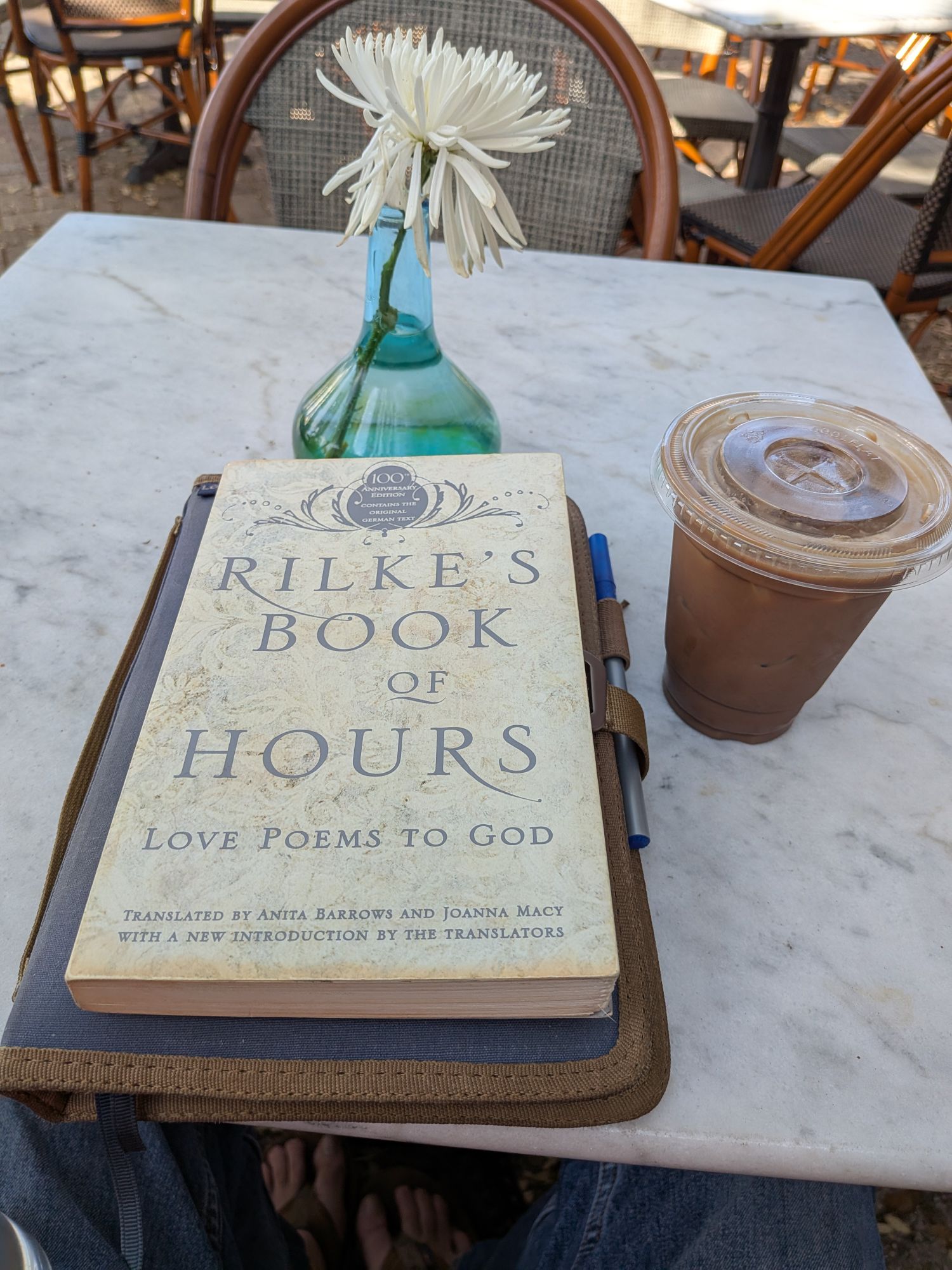
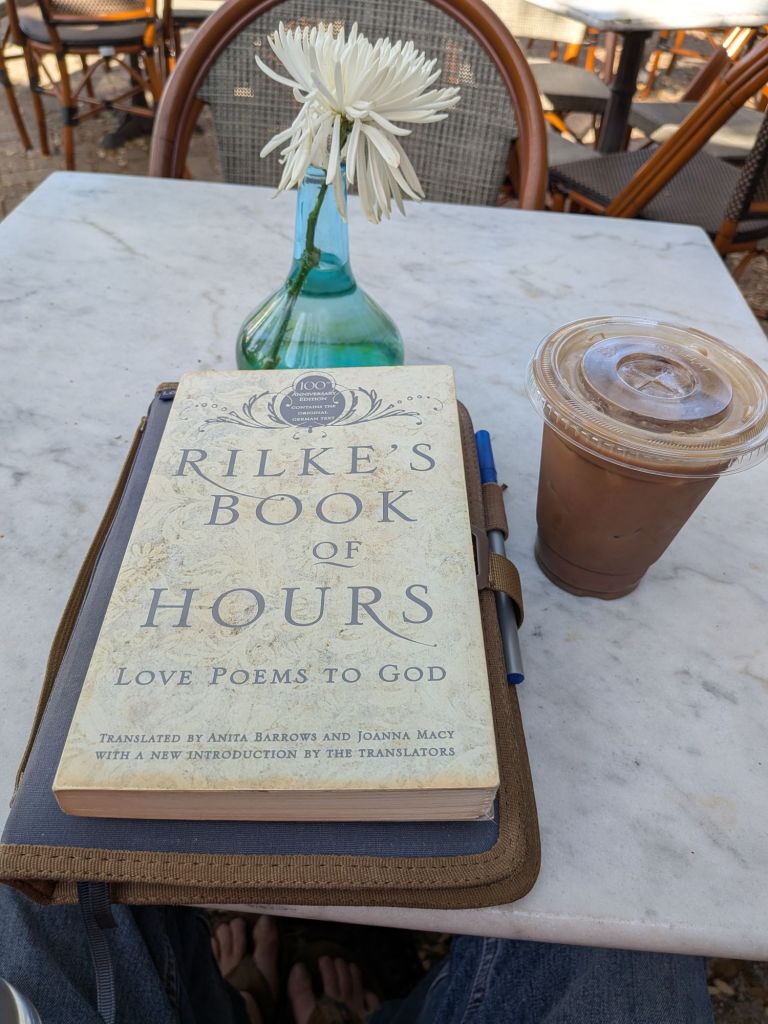
Upon entering I ordered my drink and turned to find a flyer for an ongoing writers’ workshop hosted at the venue. As I turned back around, the barista, eyeing the book I had been inspired to bring with me, brought out her own: a work by Rilke.
Mine? “Rilke’s Book of Hours: Love Poems to God.”
Indeed.

